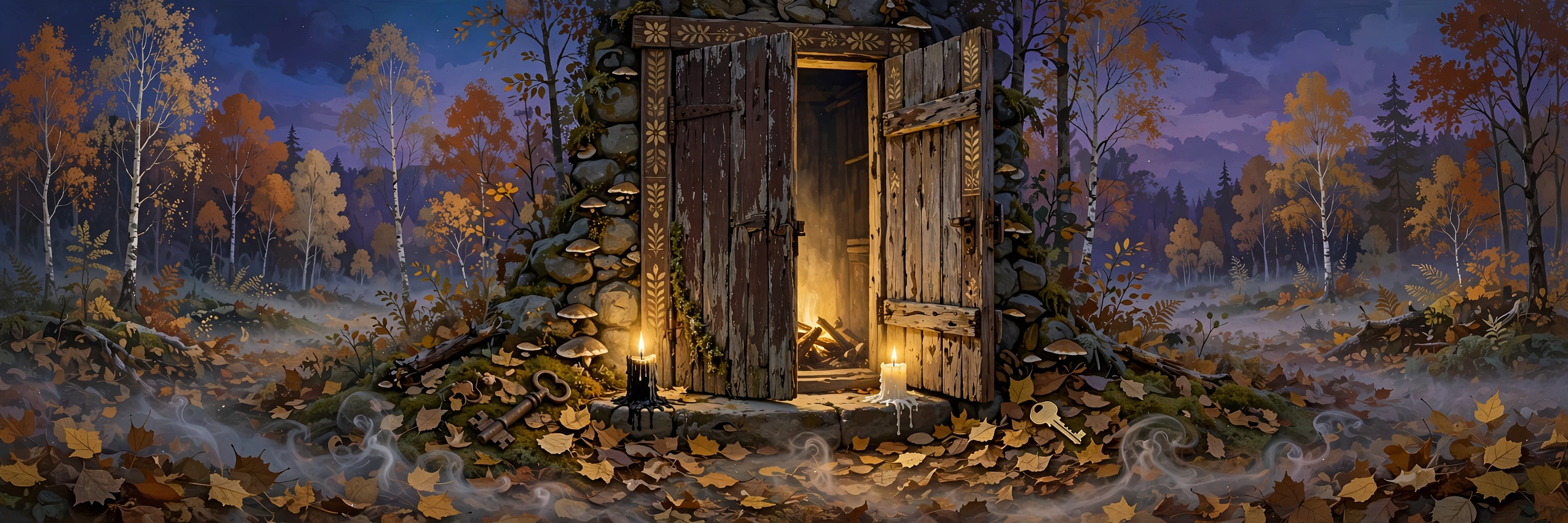
Under the costumes and the candy, Halloween is still the oldest idea there is, the year has a hinge, and this is it. Before I get to the working, I want to walk through how this night actually got here, because the road it walked is the whole reason it is worth working with at all.
How We Got Here
Halloween did not arrive whole. It was built, piece by piece, over two thousand years, and every hand that touched it left something behind.
Samhain, 500 BCE
It starts with the Celts, in Ireland, Britain, and northern France. Samhain marked the end of the harvest and the Celtic new year on November 1st, and it was believed the boundary between the living and the dead went thin that night. Bonfires were lit to ward off harmful spirits, costumes of animal skins were worn for protection, food was left out for the wandering dead, and livestock were brought in close for the winter ahead.
Rome, 43 CE
When Rome conquered Celtic territory, Samhain got folded into two Roman festivals already close to it on the calendar, Feralia, a day for honoring the dead, and Pomona, a festival for the goddess of fruit and trees. That second one is where apple bobbing actually comes from.
The Church, 400 CE
As Christianity spread, the Church set November 1st as All Saints Day, honoring saints and martyrs, and November 2nd as All Souls Day, for praying over souls in purgatory. October 31st became the vigil before it, All Hallows Eve, and that name is the one that wore down over the centuries into Halloween. The old practices did not disappear, they just kept going underneath the new name.
Coming to America, 1800s
Irish and Scottish immigrants carried it across the ocean, especially during the Irish Potato Famine. It settled into community harvest gatherings, pranks, and party games, apple bobbing and fortune telling among them, and by the Victorian era it had turned into something social rather than something spiritual.
Trick-or-Treating, 1920s onward
This grew out of souling, going door to door for soul cakes in exchange for prayers, and guising, performing a trick in exchange for a treat. Towns started organizing parades and parties to cut down on vandalism, and the night shifted from an adult, supernatural affair into the child-centered, neighborhood tradition it is today.
The Threshold Rite
Two candles this time instead of one, because Samhain was never about one thing ending, it was about two things meeting at the same moment, the year behind you and the year ahead of you, standing in the same doorway.
Cleanse
Wipe both candles down with a cloth dipped in salt water or Florida Water, or hold them and breathe on them three times, asking that they be made clean and empty, ready to hold your work and nothing else.
Carve
Into the black candle, carve what you are setting down from the year behind you, a name, a habit, a grief, a thing that has run its course. Into the white candle, carve what you are opening the door to for the year ahead.
Dress
Oil the white candle working toward you, drawing in what is coming. Oil the black candle working away from you, releasing what is going. Start at the middle and work outward, or ends to middle, whichever you were taught, and stay consistent between the two.
Seal
My own way, not something out of a book. I prick my finger and wipe the blood onto both candles, same direction as the oil, right along the carved words. I am not only thinking of my intention, I am thinking of the blood of Christ and His sacrifice, so the working is not carried by me alone.
Light
Light both candles together, at the same moment, not one after the other. The old year and the new year meet right here, in the same breath, the same match. Speak the incantation below while they burn.
The Incantation
The wheel has turned, the harvest is in,
the old year closes, the new begins.
Tonight the door stands thin as thread,
I light this flame for the living and the dead.
What I carried, I set it down here,
what has run its course, I release without fear.
What I am opening, I open with care,
what is coming toward me, I welcome it there.
Those who came before me, you are welcome at my door,
sit a while if you are weary, you are kin, not more.
I ask no harm follow you in,
only rest, only peace, only kin greeting kin.
1, 2, 3, by the power of the trinity
Closing the Door
Once both candles have burned all the way down, close the working the way my grandmother used to say it, old keys open new doors, and new keys close old doors.
Set an old key by the black candle
Something found or kept, not one you still use. It stands for the door you just closed. Leave it there until the wax is cool.
Hold a new key through the white candle burn
Any key that opens something in your life now. Keep it in hand until the flame goes out on its own, then set it on your windowsill or altar for the year ahead.
✦ ✦ ✦
What It Is Really Saying
Every hand that touched this night, Celtic, Roman, Christian, immigrant, added something and kept something. That is what a threshold is, not an ending by itself, but two things held at once, the door still open on both sides. The black candle and the white one are not opposites fighting for the room, they are the same turning, seen from either side of it.
A Few Notes
- This works any evening in the days leading up to Halloween, it does not have to be the 31st itself, the veil is said to stay thin the whole week.
- If you want to go further, set one plate at your table that evening, unspoken for, the way a mute supper is done.
- Keep the old key somewhere you will see it, a reminder of what you already closed the door on, so you do not go back and open it again by accident.
✦ ✦ ✦
Scripture
To every thing there is a season, and a time to every purpose under the heaven: A time to be born, and a time to die.
Ecclesiastes 3:1-2 (KJV)