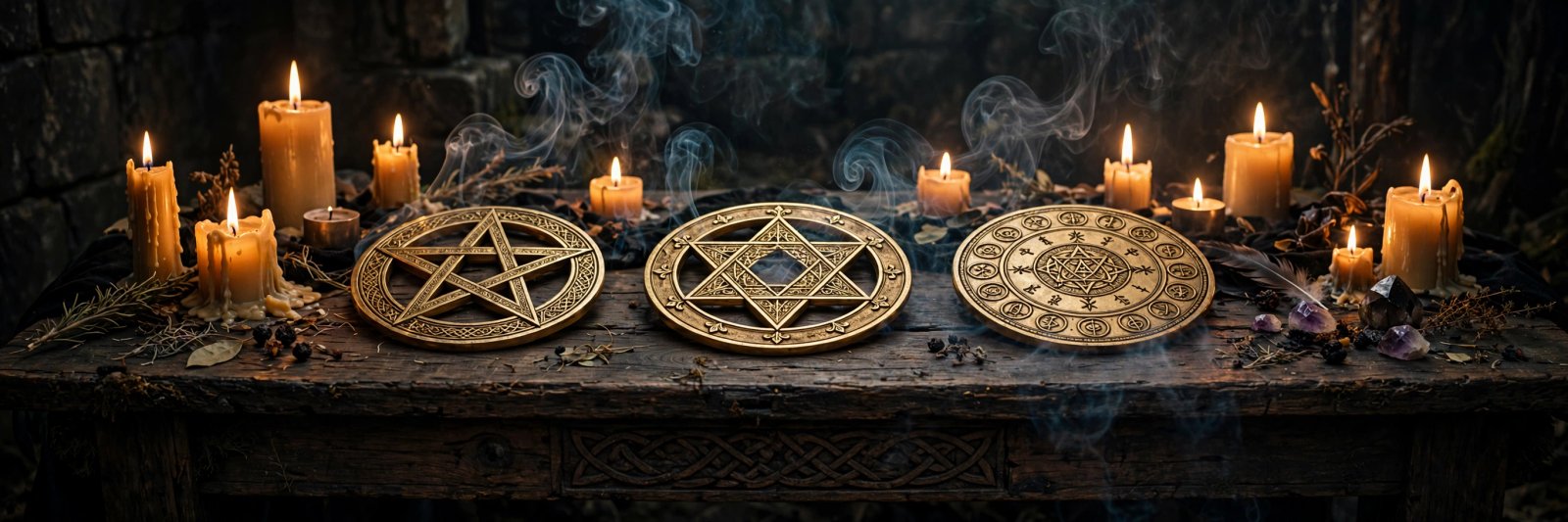
Three Symbols, Often Confused
Folks lump these together online all the time, usually because they look similar at a glance or because a movie prop department could not be bothered to get it right. They are not interchangeable, and they do not come from the same well. Here is what actually sets them apart.
The Pentacle — Five Points, Many Hands
The pentacle is a five-pointed star, most often drawn inside a circle. The circle matters as much as the star; it is what turns a shape into a symbol of protection and unity rather than just five lines crossing.
- Earth — the point at the bottom, grounding and body
- Water — the lower left point, emotion and intuition
- Fire — the lower right point, will and passion
- Air — the upper left point, thought and breath
- Spirit — the single top point, the divine that governs the other four
Point-Up and Point-Down
Point-up is the most common orientation and represents spirit presiding over matter, ascending. Point-down turns that on its head, spirit descending into the earthly, the body, the material world. Point-down gets a bad reputation it did not earn on its own; a shape does not carry evil in it, the intention and tradition behind the hand that draws it does.
In Christian and Folk Practice
This is where I want new witches paying close attention, because it gets left out of every listicle. The five-pointed star has a documented place inside Christian symbolism going back centuries, tied to the five wounds Christ carried on the cross — hands, feet, and side.
Isaiah's suffering servant passage, long read by Christians as prophecy of those wounds, is where a lot of granny women I have known would rest their understanding of the symbol when they used it for protection work:
So when you see an inverted pentacle painted as automatically sinister, know that is a fairly recent, Hollywood-driven idea. In older Christian usage and in a lot of Appalachian folk practice, both orientations of the star have carried protective, even devotional, meaning. The symbol is a vessel. What fills it depends on the tradition and the intention of the one holding it.
The Star of David — Magen David
Six points this time, made of two overlapping triangles. This is the primary symbol of Judaism and the Jewish people, called the Magen David, meaning "Shield of David."
- Formed from two interlocking triangles, one pointing up and one down
- The central symbol on the flag of the State of Israel
- Represents the connection between the divine and the earthly realm, heaven reaching down and humanity reaching up
- Belongs specifically to Jewish tradition and identity — it is not a general-purpose magic symbol to borrow for a spell
This one deserves a straight word: it is not ours to repurpose. If you are not Jewish, this symbol is not a tool for your altar or your protection work, full stop. Know it, respect it, and leave it where it belongs.
The Seal of Solomon
Here is where the confusion really tangles up, because the Seal of Solomon is sometimes drawn as a plain hexagram — visually identical to the Star of David — and other times drawn with additional markings, names, or a pentagram instead of a hexagram entirely. The shape is not fixed the way the Magen David is; the tradition around it is what defines it.
- Tied to a legendary ring belonging to King Solomon in Jewish, Christian, and Islamic folklore
- The ring is said to have given Solomon authority over spirits, demons, and even animals
- Described at length in the Testament of Solomon, an apocryphal text likely compiled between the first and fifth centuries, where Solomon commands and binds demons by name using the ring
- Referenced in the Quran (Surah An-Naml, 27:15-44), where Solomon is given command over the wind, the jinn, and the speech of birds and ants
- Appears throughout later grimoires, most notably the Key of Solomon, as a seal used in ceremonial and folk magic to compel or bind spirits
In Folk Magic and Grimoires
By the time this symbol reaches hoodoo, European ceremonial magic, and various strands of folk practice, it has picked up a reputation as a working tool — something drawn, inscribed, or carried to grant power over spirits rather than simply to represent a faith the way the Magen David does. That distinction is the whole point: one symbol names a people, the other names a working.
At a Glance
Pentacle
5 points, usually circled. Elements and spirit. Used across Wiccan, pagan, and some Christian folk traditions. Meaning shifts with orientation and intention.
Star of David
6 points, two triangles. Belongs to Judaism specifically. Represents divine-earthly connection. Not a borrowed working symbol.
Seal of Solomon
Shape varies, often 6-pointed. Rooted in legend of Solomon's ring. Used across grimoires and folk magic as a tool for binding and working.
Every symbol you pick up carries the fingerprints of everyone who used it before you. Learn whose hands shaped it, what tradition it grew out of, and what it actually means before you ever put pen, needle, or paint to it. That is not gatekeeping. That is just doing right by the knowledge.
Hold fast that which is good.
Know what you wear
before you wear it.