How the Layout Works
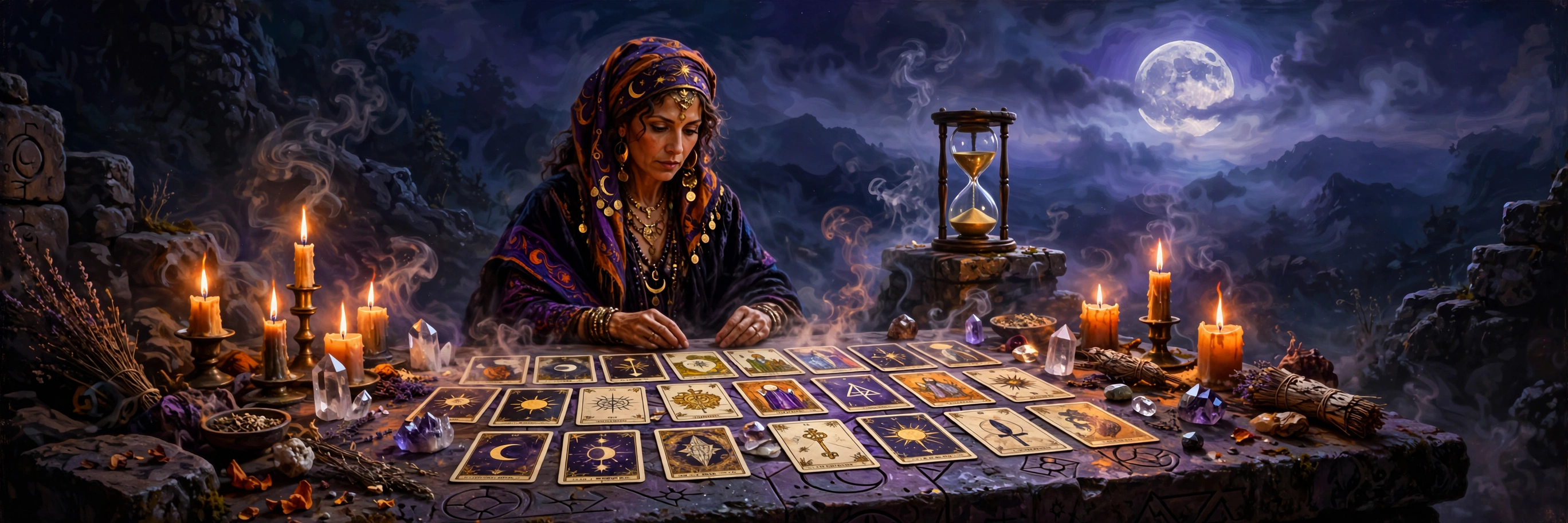
Twenty-one cards. Three rows of seven, dealt left to right. The first row is the Past, the second is the Present, and the third is the Future. That's the entire structure — there's no diamond, no cross, no cards crossing or covering one another. Just three long rows, read the way you'd read a page: left to right, top to bottom.
Each row carries a theme, but no single card is assigned a job the way "the outcome card" or "what crosses you" is assigned in other spreads. Every card in the Past row is simply Past — memory, root, early influence — and it's up to the reader to see how the seven of them build on each other into something whole.
Why You Would Use This Spread
The Gypsy spread isn't built to answer a single question. It's built to show the shape of a life, or a long season of one — where it's been, where it's standing, and where it's leaning. Reach for it when:
- Someone wants a general reading, not a narrow one — "what do I need to know right now" rather than "will this one thing happen"
- You want to open a longer session with the big picture before narrowing into something like the Celtic Cross or the Spiritual Diamond
- The story needs room to breathe across twenty-one cards instead of being forced into five or ten
- You're comfortable reading intuitively, in flow, rather than plugging cards into fixed positions
How the Cards Speak to Their Neighbors
This is the part that trips people up the most, so let's be honest about it: there is no fixed rule. Direction doesn't matter. A card doesn't have to "come from" the one on its left or "move toward" the one on its right. Sometimes two cards sitting side by side will lean into each other and change what the other means. Sometimes a card doesn't touch its neighbors at all — it just stands there and tells its own piece of the story, complete on its own.
The skill isn't in applying a formula. It's in noticing when the cards want to talk to each other and when they don't. Three Kings appearing across a row is worth noticing as a cluster. A sudden reversal breaking open right next to a court card is worth noticing as cause and effect. But if a card just sits there quiet and whole, let it. Don't force a relationship that isn't there.
None of this replaces the card itself. Intuition is the seasoning, not the meal. Read the card for what it says first — its traditional meaning, plain and unadorned — before any feeling or impression gets layered on top. If you skip straight to intuition, you're not reading tarot anymore, you're just guessing with a prop in your hand. The card speaks first. Then, and only then, does the emotion or the knowing get added to it.
A Reading, Read Aloud
Here's what that looks like in practice — a real twenty-one card pull, read for a client, row by row. Each row is broken into two passes: what the cards themselves say, and only after that, what comes through as intuition once the cards have already spoken.
Past
The cards: An unfair situation left unresolved, followed by a gentle, quiet opening. Friction and competing agendas swirl in next, then a feeling of being trapped — though the cage is more mental than real. Skilled, recognized work sits at the center of the row, but the Wheel turns against resistance, and the row closes on someone circling back to something they hadn't fully left behind.
Reading it for you: Things didn't easily go your way, but you always looked at the glass half full. Everyone wanted a piece of you — their problems always felt bigger than your own, and you pushed ahead without looking where it might land, making sure they could keep moving forward. Everyone should be covering everyone else's back. Things kept moving in the direction they were always going to move, no matter how hard you tried to hold it back — their choices came about, and you couldn't prevent it.
Present
The cards: A stalemate breaking open, clarity forced whether it's wanted or not. Three Kings gather in this row — fire, water, and mind, all mastered — bracketing real contentment and generosity moving freely between people. The Five of Swords sits in the middle of that court, a win that costs more than it should, before the row closes on clear-eyed authority.
Reading it for you: The blindfold is off. You're seeing more clearly, and with this clear vision, you can move forward — others will follow. Instead of pushing, you have enough, but there is more. Just ask and you will receive, as you have done for others, so shall you do for yourself. On your deck, the Five of Swords shows a figure looking back over his shoulder, tongue out — read here as leaving the past behind and moving forward. You're standing in the position of winning. All is almost done. One king left to conquer — the King of Pentacles — and he didn't appear anywhere in this spread. That absence says you still face the problem of keeping something for yourself.
Future
The cards: A pull inward to rest and reflect, followed by a tight, protective grip on resources. Too many options float past without discernment yet applied, anchored by a card about legacy and what's meant to last. Then it accelerates — bold, fast movement, a caution to check who's being honest, and a fresh, curious spark to close the row.
Reading it for you: You'll have some time to rest and relax, against the crowd. Then there's that money card, where you're hoarding it instead of using it for yourself. A lot of choices — this time is for you. You'll make the right moves so everyone will be happy, able to satisfy that need to still help people. When things take off, it will move fast — but there are lessons to learn first. You'll move in the correct direction, above the dangers of failing.
Notice the order in each row: the traditional meaning came first, plain and un-embellished, and only after that did the personal, intuitive read get layered in — the glass-half-full pattern, the missing King of Pentacles, the hoarding instead of using. Notice too what happened with the neighbors: the Kings in the Present row got read as a cluster — three of them stacking up meant something together, and the missing fourth mattered just as much as the three that showed. But the Five of Swords in that same row didn't borrow from its neighbors at all — it stood alone and spoke through its own deck-specific imagery. Both things happened in the same seven cards, on top of a foundation that started with what the cards themselves said. That's the spread working the way it's supposed to.
Some cards sing alone.
Lay them all down, and listen
for which is which.