One Week, Seven Days
October 28 – November 3, 2026
Halloween is not one night. When you line up the old calendars, Celtic, Catholic, and Mexican, there are seven days from October 28th to November 3rd stacked against each other, and each one has its own work. Open the week on the first evening, work with one day at a time, and close the door properly on the last so nothing is left standing open.
Each day below is a drop-down with the holiday and its background, a Bible reading, and a ritual for the day. A few of these days change from one region to the next, so go by your own tradition where it says something different. You do not have to do all seven. Open, close, and fit in what you can between.
Opening the Week
Wednesday evening, October 28
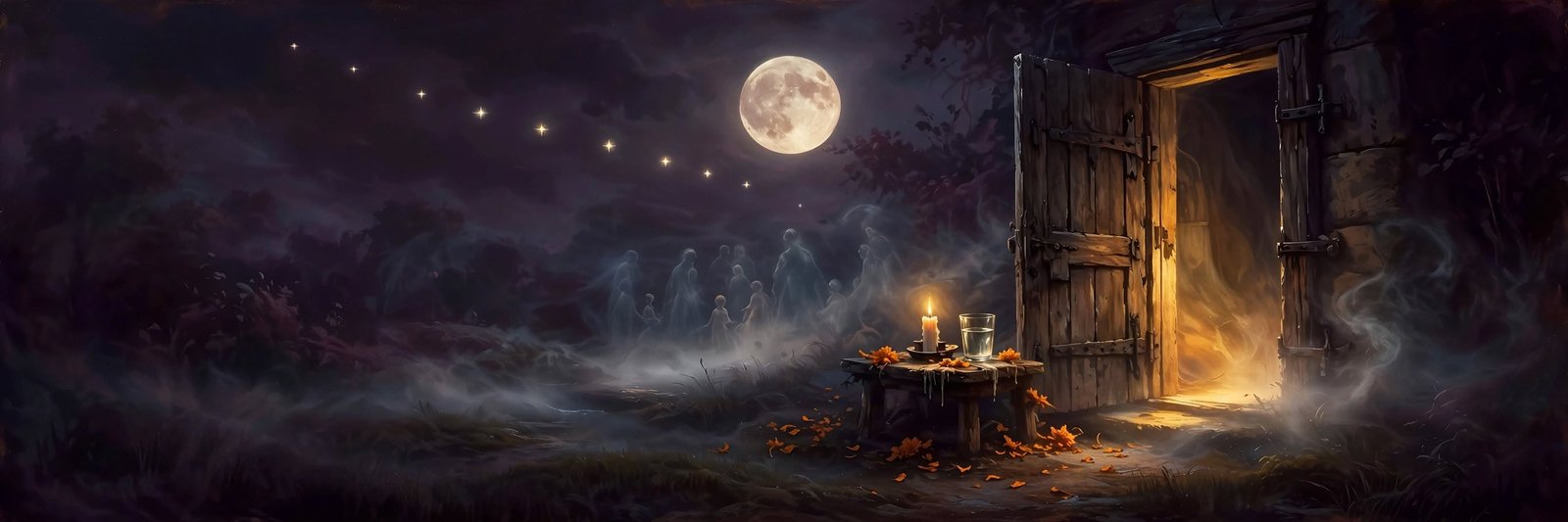
Do this once, on the first evening. You need a front door, a small white candle in a holder, a glass of fresh water, and a pen and a slip of paper. For the rest of the week the candle and the water stay in the same place, and the candle is relit each evening for a little while.
1. Wipe down the threshold and stand in the doorway, half in and half out. Open the door and take a breath. 2. Set the glass of water and the candle together on a small table near the door. In many traditions the spirits arrive thirsty, and water is the first welcome. 3. Light the candle and read the scripture below aloud. 4. Say the opening words. 5. Write one lost cause of your own on the slip of paper, fold it, and slide it under the glass. It stays there all week. 6. Close the door when you are done. The door is open in spirit, not for the whole neighborhood.
Opening Scripture
Behold, I have set before thee an open door, and no man can shut it. Revelation 3:8 (KJV)
The Opening Words
The door is open, the light is lit, there is a place for you to sit. Come as kin and come in peace, rest a while, and then release. 1, 2, 3, by the power of the trinity.
The Seven Days
The holiday, the reading, and the ritual for each day
This is the feast of the apostles Simon the Zealot and Jude Thaddaeus. St. Jude is the patron of lost causes and desperate situations, which is why he is a favorite in folk Catholic and hoodoo work. In some parts of Mexico this is also the first day of the spirits' arrival, said to be for those who died suddenly or by accident. Regional customs differ, so go by your own tradition.
Scripture
But ye, beloved, building up yourselves on your most holy faith, praying in the Holy Ghost, keep yourselves in the love of God. Jude 1:20-21 (KJV)
Ritual of the Day
After the opening rite, speak your lost cause out loud to St. Jude, plainly, the way you would to a friend. Then leave the candle to burn down a little and put it out.
In some traditions this is the day for the ánimas solas, the lonely souls, the ones with no family left to remember them and no altar set in their name. It varies from region to region, so treat it as a custom that many keep, not a fixed law.
Scripture
Yea, they may forget, yet will I not forget thee. Behold, I have graven thee upon the palms of my hands. Isaiah 49:15-16 (KJV)
Ritual of the Day
Set a small dish of water and a piece of bread by the candle. If you have a name, speak it. If not, say: You are not forgotten. Come and rest.
Mischief Night, also called Devil's Night in Detroit, is the night of pranks before Halloween in parts of the United States. In some regions of Mexico this is also a day remembered for children who died before they could be baptized. The day carries two faces, the playful and the tender.
Scripture
A time to weep, and a time to laugh; a time to mourn, and a time to dance. Ecclesiastes 3:4 (KJV)
Ritual of the Day
Play first: do something harmless and silly, hide a coin for someone to find, or tell a good ghost story. Then go quiet and set a small toy or sweet by the candle for the children who come next.
Samhain was the Celtic end of harvest and the start of the new year, and it was believed the boundary between the living and the dead grew thin. The Church later placed All Saints Day on November 1, and the night before became All Hallows' Eve, then Halloween. Bonfires, costumes, and food left out for the dead all come from this old meeting of the worlds. The dumb supper, a silent meal with a place set for the dead, comes down through Appalachian and Southern folk practice.
Scripture
If I say, Surely the darkness shall cover me; even the night shall be light about me. Yea, the darkness hideth not from thee. Psalm 139:11-12 (KJV)
Ritual of the Day
Hold a dumb supper. Set the table with one extra plate and chair for the ones who are not there, and put a little of your meal on it. Eat in silence with the candle lit. When you are done, say thank you aloud, and set the plate outside by morning.
In Mexican tradition the children return first, and November 1 is Día de los Angelitos, the Day of the Little Angels, sometimes called Día de los Inocentes. Their altars are dressed in white flowers, candles, toys, sweet bread, and small treats. The Church calls the same day All Saints, honoring the saints and martyrs.
Scripture
Suffer the little children to come unto me, and forbid them not: for of such is the kingdom of God. Mark 10:14 (KJV)
Ritual of the Day
Light a second white candle beside the first. Put out a toy, a sweet, or a small white flower for a child gone too soon, and say their name, or the name of any child you are remembering.
The adults are welcomed home. Altars, called ofrendas, carry marigolds (cempasúchil), pan de muerto, sugar skulls, photographs, and the foods and drinks the dead loved in life. Families spend the day at the graves, cleaning and decorating them and sharing a meal. The Church observes All Souls Day, and in England and Ireland the old custom of souling traded prayers for the dead for soul cakes. Día de los Muertos belongs to Mexico and to the families who keep it, so borrow the pattern with respect.
Scripture
I am the resurrection, and the life: he that believeth in me, though he were dead, yet shall he live. John 11:25-26 (KJV)
Ritual of the Day
Set out photographs of your own dead, with their favorite food or drink, and a flower if you have one. Speak their names. If you can, visit a grave and leave something there, or bake a small soul cake and share it.
St. Martin de Porres was born in Lima in 1579, a Dominican lay brother of mixed race who became known as a healer and a friend to the poor and to animals. He is the patron of barbers, public health, and racial harmony, and he is always pictured with a broom. The same day is the feast of St. Hubert, patron of hunters. St. Martin was canonized in 1962.
Scripture
He healeth the broken in heart, and bindeth up their wounds. Psalm 147:3 (KJV)
Ritual of the Day
Pray for the living today: anyone sick, anyone grieving, and any animal that needs care. Then do the closing rite below.
Closing the Week
Tuesday, November 3
Do this in the daytime, with a broom. The spirits have been fed and the door has stood open long enough.
1. Share the food. Whatever sat on the altar, eat it or give it away. 2. Take down the photographs and set them back in their places. 3. Pour the water out at the base of a tree or plant, not down the drain. 4. Take the paper from under the glass and burn it safely in a dish, or bury it. 5. Sweep from the back of the house toward the front door, and out over the threshold, saying the closing words as you go. 6. Put the candle out with a snuffer or your fingers, not your breath, and close the door.
Closing Scripture
The LORD shall preserve thy going out and thy coming in from this time forth, and even for evermore. Psalm 121:8 (KJV)
The Closing Words
The week is done, the door swings shut, the house is swept, the way is cut. Go in peace and go in grace, and leave the living their own place. 1, 2, 3, by the power of the trinity.