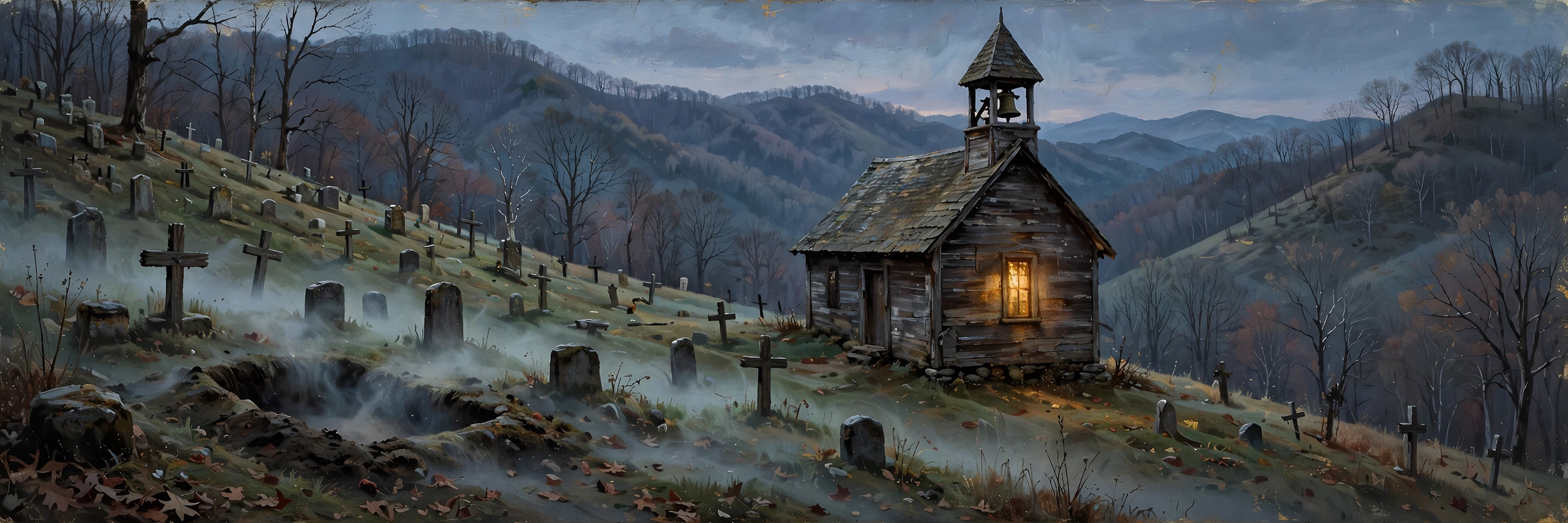
Counting the Tolls
There was no phone call, no obituary in the paper yet, no text passed hand to hand. There was only the church bell, and a woman standing still in her kitchen or her garden, counting. One toll, two, three — all the way up through however many years the departed had lived. By the time the last toll faded, she already knew who it was, or close enough to it, before anybody came up the road to tell her.
That counting was its own kind of respect. It meant the whole holler stopped together, if only for a minute, and reckoned with what had just happened before a single arrangement was made.
A Job for Every Hand
Nobody sat idle once the bell had told its count. Death didn't stop the holler — it just gave everybody in it a job, and every single one of us, young or old, male or female, stopped what we were doing and did it.
The Women's Work
The women of the holler cleaned the body and prepared it for burial, a task carried out with the same care and quiet as any other piece of women's work.
The Men's Work
The men dug the grave and built the coffin, working with their hands to make the ground and the box ready.
The Sitting-Up Watch
The older children kept watch over the body for two to three days, making certain the person was truly gone, or until a doctor arrived to pronounce it official.
The Children's Work
The younger ones went off to play, sometimes with the deceased's own children, finding something to occupy their hands and hearts while the older folks did theirs.
It didn't matter what your job was, only that you did it. That was the order of things.
The Satchel — Alum and Baking Soda
Grandma's satchel always held alum and baking soda, and the other women of the holler brought their own supply of baking soda along too when the bell tolled. But not every woman kept alum on hand the way Grandma did. That was a thing that took the better part of a day to make, and not everybody had the time, the know-how, or the reason to keep it ready. It's part of why it stuck in memory long after the rest of the satchel's contents were forgotten.
Alum wasn't a death remedy alone, either. It had its hand in plenty of ordinary holler life — canning and pickling, doctoring a sore mouth or a cut, settling water, even styptic use for a nick or a shave. Death work was just one more thing it was called on for, not the whole of what it was for. We'll give alum its own page before long, since there's a lot more to it than what belongs here.
Grandma's Part
Grandma's job wasn't only what she carried in the satchel. She had a hand in comforting the ones left behind as much as she did in preparing the ones who'd gone. She sat with the grieving, held their hands, and gave them somewhere to put their sorrow so it didn't just sit in them unspoken.
And she believed her work didn't stop at comforting the living. Part of what she did was help the deceased cross over — easing the passing itself, so the one who'd gone could move on peaceful and unburdened, and so the ones left behind could trust that they had.
Sometimes another woman from the holler had already started preparing the body before Grandma got there. It didn't matter. The moment Grandma walked in, that woman would step back and let Grandma take it from where she'd left off. Nobody had to ask.
Part of Grandma's job was seeing to it that every mirror in the house got covered. It wasn't just a tidiness thing or a mark of mourning — the belief was that a mirror could catch the spirit of the newly departed and trap it, keeping it from crossing over the way it was meant to. Covering the glass kept the way clear.
A bowl of salt water was set by the deceased as well, kept near the body through the sitting-up watch. Salt has long stood for protection and purification in these traditions, and the water beside the body was there to help keep the space clean and to ease the spirit's passing, same as the covered mirrors did.
Where the Body Was Laid
If a family had its own graveyard — a plot where the ancestors already rested — the burial happened there, on land the family already knew and kept. If they didn't, the body was brought up to the church instead, and buried in the churchyard alongside everyone else the holler had lost.
Markers weren't always carved stone. Often they were makeshift, put together with whatever could be had at the time. But the church kept its own record of who was laid where, so that even a plain marker or none at all didn't mean a person was forgotten. The record remembered what the ground couldn't say on its own.
Before Winter Set In
Ground freezes hard in the mountains, and a shovel does no good against it. So before winter set in, graves were dug ahead of need and covered over with wood at the church, ready and waiting for whoever the bell would toll for next. It was practical, but it was also its own kind of preparedness — the holler getting ready for what winter would eventually bring, the same way it put up canning and stacked its woodpile.
The women made the body ready.
The men made the ground ready.
The children kept the watch,
and the little ones kept playing —
because grief needs both.
"So teach us to number our days, that we may apply our hearts unto wisdom." — Psalm 90:12 (KJV)