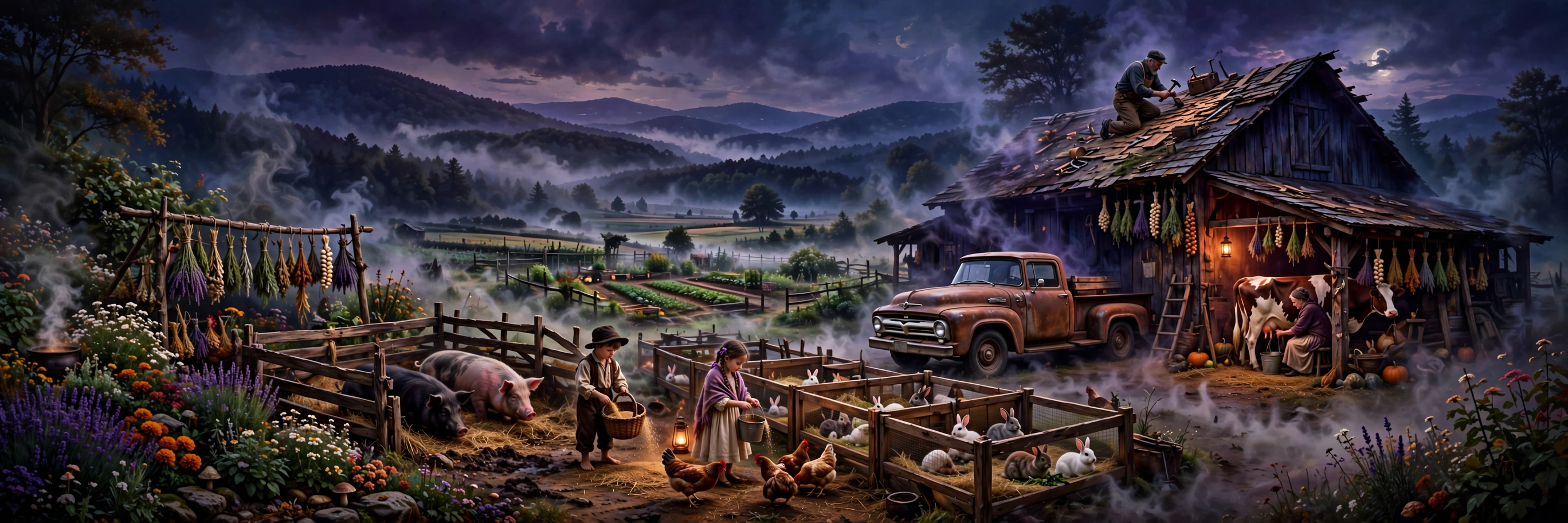
She never had to explain it twice, and she never let it slide, not even for the softest-hearted grandkid. If you started sweet-talking one of the hogs by name, she would put a stop to it before the name ever stuck. It sounds harsh set down in words like this. It made perfect sense standing in that barnyard.
The Practical Reason
The plain reason was killing time. Everything that was going to end up on the table stayed nameless on purpose, because it is a different thing entirely to butcher a hog than it is to butcher Wilbur. You have heard the old saying about running around like a chicken with its head cut off. Grandma would tell you plainly — they really do. She was not going to make that moment any harder on the kids, or on herself, by handing a name to something that was never going to see next winter.
The Spiritual Reason
Beside the practical reason, Grandma held to a spiritual one just as firmly, and she was adamant about it. To call something by its given name is to gain a kind of hold over it. She said if you are going to pray for somebody, you had better know their name. If you are banishing something, or calling someone out, you had better know their name too. A name is not just a label in her way of thinking. It is a handle, and whoever is holding the handle is the one with the say-so.
Why Names Carry Power
-
I
Precision
Energy follows attention, and attention follows a name. Naming exactly who or what you are working with keeps the working from drifting onto the wrong target.
-
II
Authority
In many old traditions, knowing a spirits true name, or a persons full given name, is what gives you the standing to command it, bargain with it, or call on it at all.
-
III
Waking It Up
Speaking the name of a plant, a stone, or a tool is said to wake up what is sleeping inside it, turning a mundane thing into an active ally.
-
IV
Taking the Power Out of a Thing
In banishing work, naming a hidden fear, a bad habit, or a hex outright is what takes its power away. Bringing it into the light by name is the whole of the working.
Old Traditions That Agree With Her
Grandmas rule was not just a mountain oddity. The idea that a name is a kind of claim runs through a lot of old practice, in and out of the hollers.
- In hoodoo and rootwork, a name paper carries a persons actual name as the anchor of the working, not a description of them — the name is what directs the power to the right place
- Greek and Roman curse tablets were inscribed with the precise name of a rival or a thief before being sealed and buried, so the working would find the one it was meant for
- In the old European tales, a monster or a demon loses its hold the moment someone guesses and speaks its true name out loud
- Poppets and conjure dolls are formally named for a person in a kind of baptizing, tying the doll to that one soul and no other — a tradition close cousin to the paper dolls Grandma and I made together, which you can read about in the Power of the Proxy piece
Scripture Says the Same
Grandma kept her practice close to the Bible, and this rule was no different. She would point back to the second chapter of Genesis, to the very first naming of all.
And out of the ground the LORD God formed every beast of the field, and every fowl of the air, and brought them unto Adam to see what he would call them: and whatsoever Adam called every living creature, that was the name thereof.
God did not hand Adam a list of names. He brought the animals to him and let Adam do the naming, and whatever Adam called them, that became their name for good. The naming itself was the giving of dominion. Grandma read that the same way she read her own barnyard — the name is where the authority lives.
So that is the rule as I learned it, sitting on the porch steps while she snapped beans. Name what you love. Name what is going to sit by the fire with you a good long while. But think hard before you name what is only passing through, because a name is not a small thing to hand out. It is a claim, and once it is spoken, it does not come back easy.
Some things keep their peace by going nameless.
Either way, the naming is the choosing —
and Grandma never chose it lightly.