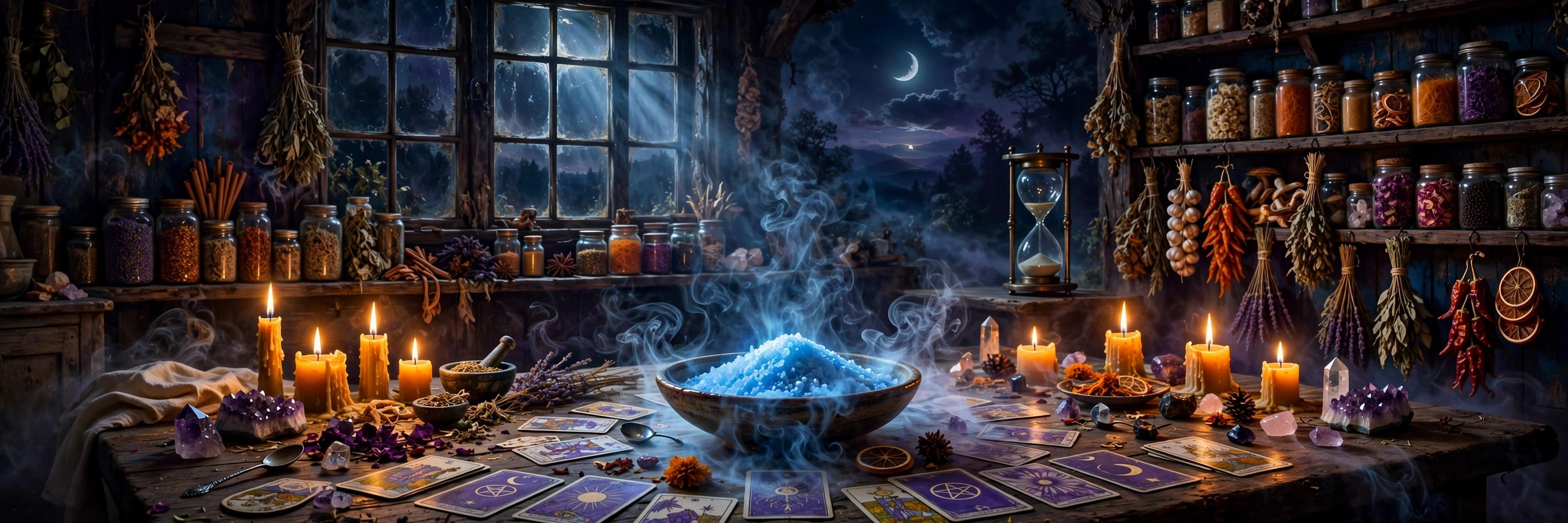
What Blue Salt Actually Is
Here's the thing nobody selling it online wants to slow down and say: salt doesn't naturally come in blue very often, and when it does, it has nothing to do with flowers. Real blue halite exists — it's been pulled up out of deposits in Poland and New Mexico and a few other places on earth — and the color comes from something called radiation-damaged color centers, tiny defects in the crystal lattice built up over millions of years underground. It's rare, it's geological, and it's got nothing to do with intention or ritual. Nobody's grinding that with a pestle on a Tuesday night.
What you and I are actually working with when we make blue salt at home is plain salt, colored by hand — crushed dried petals, a pinch of butterfly pea powder, maybe a drop of food coloring if the color needs help holding. And that's fine. That's more than fine. My grandmother used plain white table salt for everything she ever worked, no color, no dressing up, and she'd have looked at a jar of tinted salt and said the same thing she said about all of it: Annie, you got to believe. It's all in the intentions. The color isn't the magic. The color is just how you remind your hands, every time you reach for the jar, what that salt is for.
What It's Used For
Blue salt sits on the calm end of the salt family — where black salt draws a hard line and sends things away, blue salt is closer to a hand on the shoulder. It's used for warding off an envious eye or a run of bad luck that seems to be following someone around, without going as far as banishing. It gets carried into rooms where fairness matters and tempers might not stay level — a courtroom, a hard conversation, a hearing — for a steadier outcome and a clearer head. Slipped under a pillow or set in a small jar near the bed, it's meant to settle a mind that won't stop circling and help sleep actually come. And because it leans so heavily toward water — tide, intuition, the quiet work of the third eye — it fits naturally into anything built around emotional clarity rather than force.
How to Make It
I like forget-me-nots for this one — partly for the color, partly because the name does half the work for you before you've even picked up the pestle. Borage, bluebells, and cornflower all work the same way if that's what's on hand.
You'll Need
- Coarse sea salt or plain table salt
- Dried blue flowers — forget-me-nots, borage, bluebells, or cornflower
- A mortar and pestle
- Optional: a drop of blue food coloring or butterfly pea powder, if the petals alone don't hold their color
- A small glass jar with a lid
The Method
- Clear your space and settle yourself before you start — this isn't a step to rush past.
- Put a scoop of salt and your dried flowers into the mortar together.
- Grind them down with the pestle, and while you grind, hold the calm you're building toward in your mind — not a vague wish for peace, but the actual shape of it. Picture it settling like a blue-grey weight over whatever's been stirred up.
- If the color needs help once everything's crushed, add your dye or petal powder a drop at a time, mixing until it's even.
- Let it sit out and dry fully before you jar it — salt that goes into a sealed jar with any dampness left in it will clump and mold rather than keep.
- Transfer it to a clean jar, label it plainly, and store it somewhere it can be reached without ceremony — a shelf works just as well as an altar.
Mae, the woman who taught me most of what I know about spread and color work, used a whole rainbow of salts depending on what a working called for. My grandmother used the same plain white salt for every single thing she ever did. Both of them got results. That's the part worth sitting with longer than the color question.
The bowl in that photo my friend sent me was pretty. It probably works exactly as well as it claims to, for anyone who grinds their own with the same care my grandmother put into a jar that never had a drop of color in it. Salt is salt until somebody decides what it's for. After that, it's whatever you needed it to be.
Not every color is a lie.
Grind it plain or grind it blue —
the hand that does the grinding
is where the working starts.