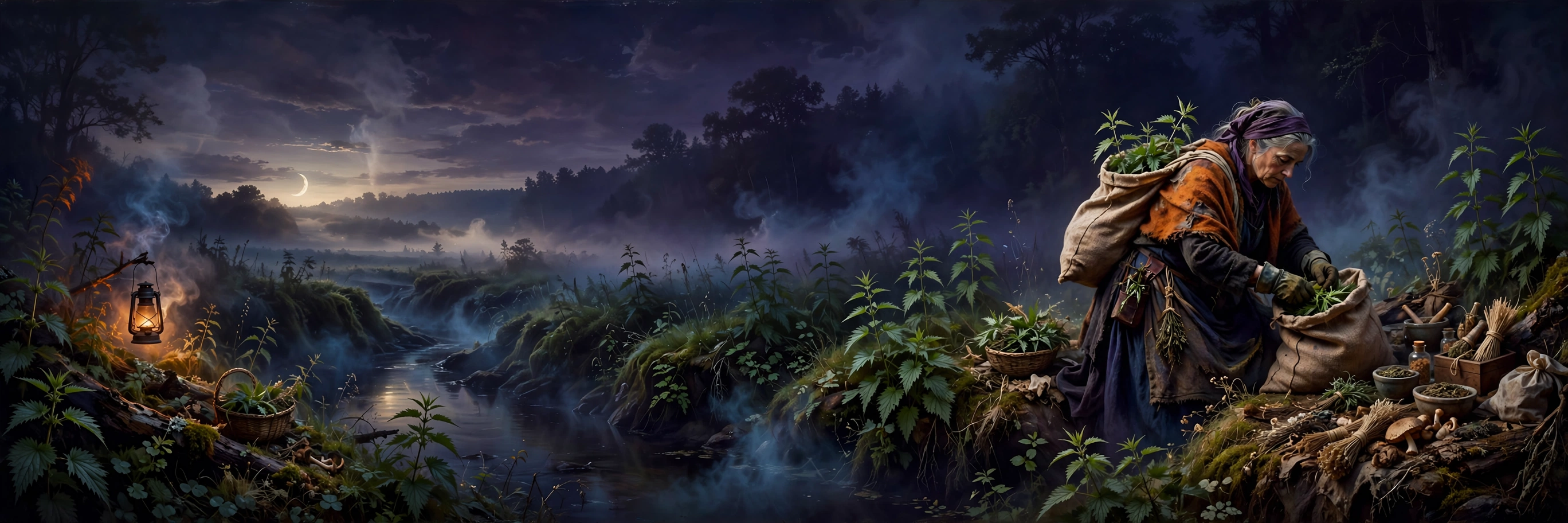
Touch it wrong and it bites you before you've even decided you want it. That is nettle's whole argument in one leaf — a weed that defends itself first and feeds you second, and asks you to earn the second part by respecting the first.
❧ A Weed That Guards Itself
Stinging nettle, Urtica dioica, is a wild, nutrient-dense weed with a long history in both the kitchen and the medicine cabinet. Pick it raw and you'll find out immediately why it earned its name — the leaves are covered in tiny hollow hairs, and every one of them is loaded with irritating chemicals that sting on contact. Cook it, dry it, or steep it, though, and that defense drops away entirely. The sting cooks out, and what's left tastes like a good, hearty spinach.
Nettle grows abundantly through the Appalachian mountains, right at home in the region's damp valleys and rich cove soils, favoring the cool, temperate climate the mountains hold onto even through a warm spring. It shows up most reliably in spring and early summer, the same window when a lot of folk foraging and spring tonic traditions were built around it — a plant that arrives right when the body most needs waking back up after winter.
❧ The Apothecary Knew What It Was Doing
Nettle has never really left the shelf. It's one of the few wild weeds that walked straight out of folk herbalism and into today's health food stores and supplement aisles, still standing on the same reputation it earned generations ago.
- Nutrient Density Rich in iron, calcium, and vitamins, nettle has long been used as a spring tonic to rebuild the blood and restore strength after a long winter.
- Seasonal Allergies Dried nettle leaf, taken as tea or in capsule form, remains one of the most widely reached-for herbal remedies for seasonal allergy relief today.
- Joint & Inflammation Support Both the tea and topical preparations have a long tradition of use for joint pain and general inflammation — some old-time practice even involved deliberately stinging a sore joint with the fresh leaf.
- Hair & Scalp Care Nettle rinses and infusions have long been used to strengthen hair and soothe the scalp, a practice that carries over into modern natural hair care lines.
❧ A Weed Worth Wearing Gloves For
Appalachian granny witches never treated nettle as an ordinary weed. A plant that defends itself the moment it's touched and then turns around and feeds and heals the hand that respected it — that's not a contradiction to a granny witch, that's the whole lesson. Green witches read the same plant the same way: something that teaches boundaries by demonstrating one, right there in the leaf.
❧ Banishing & Protection on the Shelf
Nettle's folk magic reputation follows its nature closely — this is a plant that stings first and asks questions later, and across hoodoo, granny witch, and green witch practice alike, it's turned to when the work is about defense rather than drawing something in. Across broader European and folk magic tradition more widely, exorcism sits right alongside protection and banishing as one of nettle's most consistently cited powers — a plant credited not just with keeping trouble out, but with driving something unwanted back off once it's already gotten in.
In hoodoo practice, nettle shows up in uncrossing and banishing work — added to floor washes and protection mojo bags meant to break a hex or a run of bad luck, and to keep unwanted influence out of a home. Appalachian granny witch tradition leans on it the same way, often hung dried in a doorway or window as a ward, standing alongside other thorny, defensive plants gathered for the same purpose. Green witches tend to fold nettle into boundary and grounding work more broadly — an iron-rich plant that reads, correspondence-wise, as an iron-of-the-plant-world stand-in for Mars energy: sharp, defensive, and unwilling to be pushed past. Older folk magic sources go a step further and name nettle an exorcism herb outright — sprinkled around a house to keep evil out, thrown into a fire to avert danger, or carried as an amulet against ghosts and lingering negativity.
Protection
A plant that defends its own leaves before anything else touches them is a natural fit for warding a threshold, a room, or a person.
Banishing & Uncrossing
Used in hoodoo floor washes and mojo bags to break crossed conditions and send unwanted influence back out the door it came in.
Boundaries
The sting itself is the lesson — a plant that teaches respect for a line the moment that line is crossed.
Strength & Vitality
An iron-rich blood tonic in the body reads naturally as a fortifying, backbone-building herb on the shelf.
A weed that stings before it feeds you isn't holding a grudge. It's just telling you exactly what it's for.
❧ What It Stands Beside
For protection and banishing work, nettle pairs naturally with other sharp-edged, defensive plants and materials — black pepper and salt for uncrossing, iron itself for a Mars-leaning boundary working, and thistle, its close cousin in spirit if not in family, for the same thorn-first defense. Where nettle is scarce, thistle or blackthorn make reasonable substitutes — both carry that same unmistakable message: come no closer without respect.
Some plants earn their place on the shelf by being gentle. Nettle earned its place by being honest — sting first, so you know exactly where you stand, and only then, once that's understood, does it feed you and heal you and guard your door besides.
"Both thorns and thistles it shall bring forth for you, And you shall eat the herb of the field." — Genesis 3:18 (NKJV)