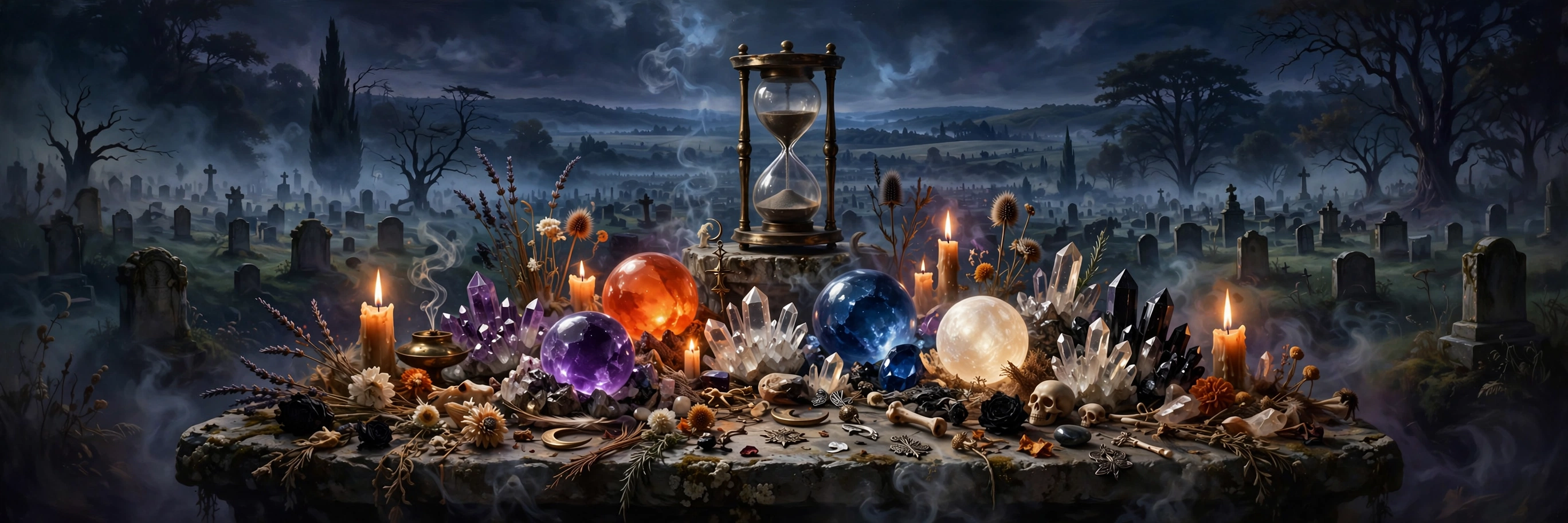
A Stone For Every Month
The idea of a stone tied to your birth is older than the jewelry counter it lives on now. It starts in the Book of Exodus, where Aaron, the High Priest of the Israelites, wore a breastplate set with twelve gemstones — one for each of the twelve tribes. By the first century, the historian Flavius Josephus had drawn a line from those twelve stones to the twelve months and the zodiac wheel. The custom of wearing just one stone, matched to your own birth month, didn't take its familiar shape until eighteenth-century Poland. The chart most of us know today wasn't standardized until 1912, when the Jewelers of America sat down and settled it for the modern market.
So the "traditional" birthstone list is really two things stacked on top of each other — a few thousand years of scripture and folk custom, wearing a hundred-year-old marketing decision like a coat.
January
Garnet — Protection
February
Amethyst — Peace
March
Aquamarine / Bloodstone — Serenity
April
Diamond — Strength
May
Emerald — Renewal
June
Pearl, Alexandrite, or Moonstone — Balance
July
Ruby — Passion
August
Peridot or Spinel — Prosperity
September
Sapphire — Loyalty
October
Opal or Tourmaline — Creativity
November
Topaz or Citrine — Abundance
December
Turquoise, Tanzanite, or Blue Zircon — Protection
Beyond the Western Calendar
That twelve-month chart is heavily rooted in Western and Judeo-Christian history, but it's far from the only system out there. Other traditions skip the birth-month altogether and build their gemstone practice around planetary alignment, spiritual purity, or the elements themselves.
Vedic & Hindu Tradition — Navaratna
In Hindu Vedic astrology, a person's stone isn't picked from a calendar at all. It's determined by their Rashi — their moon sign — and the exact planetary placements at the moment of their birth. The system is called the Navaratna, the "nine gems," and each stone answers to a celestial body, or Graha.
Surya — Sun
Ruby (Manik), for confidence and authority.
Chandra — Moon
Pearl (Moti), for emotional stability and peace.
Mangal — Mars
Red Coral (Moonga), for courage and strength.
Budh — Mercury
Emerald (Panna), for intellect and communication.
Guru — Jupiter
Yellow Sapphire (Pukhraj), for wisdom and wealth.
Shukra — Venus
Diamond (Heera), for luxury and harmony.
Shani — Saturn
Blue Sapphire (Neelam), for discipline and karma.
Rahu — North Node
Hessonite (Gomed), for clarity and protection.
Ketu — South Node
Cat's Eye (Lehsuniya), for detachment and intuition.
Islamic Gemstone Tradition
Islamic gemstone practice has never run on a calendar. Stones are worn for protection, blessing, and health, honoring the practice of religious figures who came before. Aqeeq — agate or carnelian — holds the deepest reputation of all of them, worn as a Sunnah in memory of a stone the Prophet Muhammad is recorded to have set in his own ring. Feroza, turquoise, is carried for victory and protection from the evil eye. Dur-e-Najaf, clear quartz sourced near Najaf in Iraq, stands for spiritual purity and light. And pearl and coral, Lulu and Marjan, are named directly within the Quran.
Tibetan Buddhist Tradition
Tibetan mystical charts tie specific crystals to the twelve signs of the Tibetan calendar, used to balance a person's life energy and open the chakras. Emerald has long sat in ritual malas for heart-chakra work, and ruby for compassion and generosity. Beyond single stones, Tibetan practice leans on five-color cord jewelry that mirrors the elements themselves — white for space and purity, blue for sky and clarity, red for fire and energy, yellow for earth and stability, green for water and adaptability.
The Mineral Kingdom: Hoodoo and Voodoo
Hoodoo and Voodoo don't treat a crystal as decoration. They treat it as a living, conscious container of ancestral spirit and elemental energy. Hoodoo is Southern African American folk magic, built around personal power. Voodoo — Louisiana Voodoo, Haitian Vodou — is a formalized religion centered on the Lwa and the Orishas, the divine spirits themselves. People conflate the two often enough, but they aren't the same tradition wearing two names. Instead of matching a stone to a birth month, both pick a stone for its spiritual signature — its color, its origin, its capacity to hold a charge.
Sacred Minerals in Rootwork
In Hoodoo, stones are called the Mineral Kingdom. They get fed — oils, whiskey, perfume — to keep their spirit awake and working, and they're a core ingredient in mojo bags, the flannel talismans packed with roots and minerals.
Lodestone
Magnetite. The most essential mineral in Hoodoo, fed iron filings weekly to draw money, luck, and lovers.
Pyrite
Fool's gold, worked into money-drawing bags and floor washes for wealth and business.
Petrified Wood & Agates
Grounding and ancestor work — ancient time held inside stone, an anchor to reach the dead.
Black Obsidian & Tourmaline
Heavy protection, hex-reversal, absorbing negativity and sending crossed conditions home.
Alum & Sulfur
Mineral compounds more than gems. Alum binds a gossiping tongue; sulfur breaks a hex and cleans a foot-track.
Gemstones in Voodoo & Santería
In Voodoo and its close relative Santería, or Lucumí, stones are aligned to a specific Lwa or Orisha and placed on the altar to honor that spirit, or worn to invoke its protection.
Turquoise & Aquamarine
Sacred to Yemaya — ocean depth, emotional healing, and motherhood.
Amber & Citrine
Aligned with Oshun — love, luxury, and sweetness drawn in honey-colored stone.
Carnelian & Red Jasper
Sacred to Shango and Oya — fire, passion, justice, swift transformation.
Clear Quartz
Associated with Obatala — peace, wisdom, and clarity for the mind.
Cowrie Shells
Not gems, but they carry the same weight — the eyes of the spirits, wealth, and the primary tool of divination.
How the Stones Are Woken
A crystal fresh off a store shelf is considered asleep in both traditions. Waking it takes three steps. First, cleansing — washed in river or ocean water, or passed through the smoke of the right herb, to strip out whatever energy is already sitting in it. Second, naming — prayed over directly, sometimes buried in graveyard earth for ancestor work, or left out under sun or moon to fall in line with a particular spirit. Third, feeding — dressed in a condition oil like Van Van for luck or Fiery Wall of Protection for a shield, or given rum and tobacco smoke to seal the bargain.
From Birthstones to Headstones
This part wasn't even meant to be its own section, but it's worth saying out loud: stones don't stop their work at birth. They show up again at the very end, laid on top of a grave as a universal marker of remembrance. The custom is rooted in ancient Jewish mourning tradition, and it's since spread far past any one religion, carried today by military families, veterans, and civilians alike.
A stone left on a headstone tells the next visitor, and the family, that someone came. It says the person buried there hasn't been forgotten — which matters most at the national cemeteries families sometimes travel hundreds of miles to reach. A stone holds where a flower can't. Flowers wither and blow off in a season; a stone stays put, indestructible, an unbroken thread to someone who's gone. The custom likely goes back further than any headstone at all, to a time when the dead were buried under simple cairns — mounded piles of rock — and passersby added stones to the pile to keep the wind from stripping it bare and to keep scavengers off the grave beneath it. A practical act, worn smooth into ritual over a few thousand years.
Distinguishing Stones from Coins
Walk through a military cemetery and you'll find coins sitting right alongside the stones. A stone speaks for a general visit of respect. A coin, according to the Wounded Warrior Project, carries a far more specific code — a language spoken between service members that most civilians never learn.
Penny
Left by any visitor simply grateful for the sacrifice.
Nickel
Left by a veteran who trained at boot camp alongside the deceased.
Dime
Left by someone who served in the same unit or deployment.
Quarter
Left only by someone who was physically present when the service member died.
It circles back to where we started. A coin in a mojo bag, marking the year a life began. A coin on a headstone, marking the exact circumstance of how it ended. Different pocket, same instinct — to press something small and permanent into the hand of a moment too big to hold onto any other way.
and a coin beside it, stamped with the year.
The same hand that opens a life with mineral and metal
will one day close it the same way —
a stone left standing where words run out.