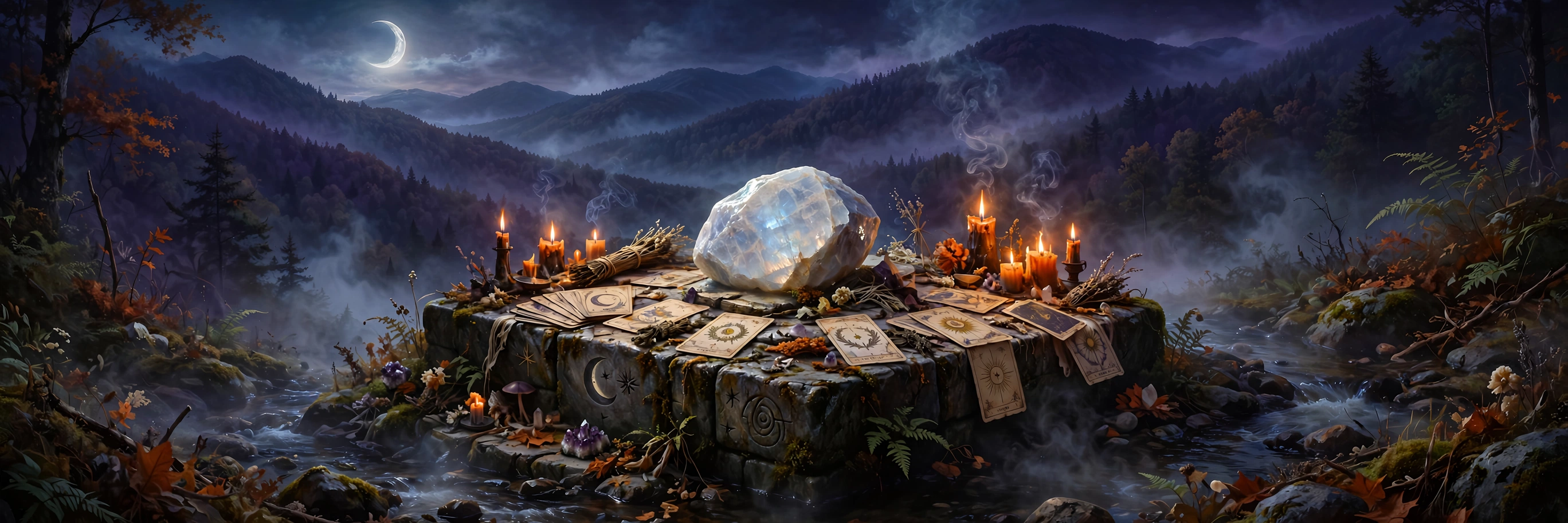
What the Creek Gave Us
I couldn't tell you, back then, why those particular stones felt different in the hand. Smoother, somehow, even before you'd rubbed them smooth yourself. We'd line them up on the porch rail to dry, and the good ones — the ones with that shimmer — got kept in a pocket, a jar, a shoebox, wherever a kid keeps her treasures. It took growing up and coming to the old ways to learn that what the creek had been handing us all along was moonstone.
It makes a strange kind of sense now. A stone tied to cycles and quiet returning, and I was finding it in moving water, in a place I went back to summer after summer without ever thinking of it as a practice. Some things get planted a long time before you have a name for them.
Moonbeams Made Solid
The shimmer in a good moonstone — that blue-white light that seems to float just under the surface and shift when you move it — has a name of its own: adularescence, light scattering across layers of feldspar laid down inside the stone like sediment. But long before anyone had that word, people looked at the same effect and came to a simpler conclusion: that moonstone was moonlight, cooled and made solid.
The Romans held that belief outright, connecting the stone to Diana and tying its shifting light to the changing face of the moon itself. In parts of India, moonstone has long been treated as sacred rather than merely decorative — set aside as a stone for the third eye, and considered too potent to be worn or handled carelessly, kept instead for quiet, intentional work.
Beyond the Creek
Wherever it turns up, moonstone tends to land in the same territory: the feminine, the cyclical, the parts of a life that come and go and come back around. In rootwork, it gets folded into workings meant to draw luck and favor in matters that move in seasons — fertility, timing, the slow turn of circumstance rather than a quick fix. In practices that keep altars for ancestors and lunar spirits, a pale stone that seems to hold its own light finds an easy home as an offering piece, something set out for the quieter conversations.
None of that traveled to me through my grandmother's hands the way some of the older remedies did. But it's not hard to see why so many different traditions, looking at the same softly glowing stone, kept landing on the same idea — that it belongs to whatever in us runs on cycles instead of straight lines.
Working With Moonstone
Element
Water
Chakra
Sacral, Third Eye, and Crown
Primary Work
Intuition, cycles, and new beginnings
What It's Used For
- Steadying the emotions and softening what's raw or reactive
- Sharpening intuition and quieting the noise around a gut feeling
- Marking a fresh start — a new chapter, a clean break from the old one
- Traditionally kept close through fertility, pregnancy, and cycle work
- Inviting dreams that carry something worth remembering in the morning
How to Work With It
Hold it as the moon changes and you'll feel it read a little differently at each phase — quieter at the new moon, fuller at the full one. Keep it on an altar for lunar work, or under the pillow if dreamwork is what you're after. During times of emotional processing, some hold it against the sacral chakra and simply breathe until the noise settles. It doesn't ask for much ceremony to do its work.
Cleansing & Charging
Moonlight is this stone's native charge, full moon most of all — set it on a windowsill or take it outside if you can. Running spring water and a pass of sage smoke both work as a cleanse if moonlight isn't available. Recharge it after each full moon, or any time it's been sitting with something heavy.
Stone Pairings
Amethyst
Deepens the intuitive and spiritual reach of both stones together.
Rose Quartz
Turns the work toward self-love and gentle emotional healing.
Labradorite
Pairs well for psychic development and moving through change.
Selenite
Clears the space and steadies the connection to lunar energy.
Some are found by accident, in moving water,
by a kid who didn't know yet what she was keeping.
The moon doesn't mind waiting
for you to learn its name.