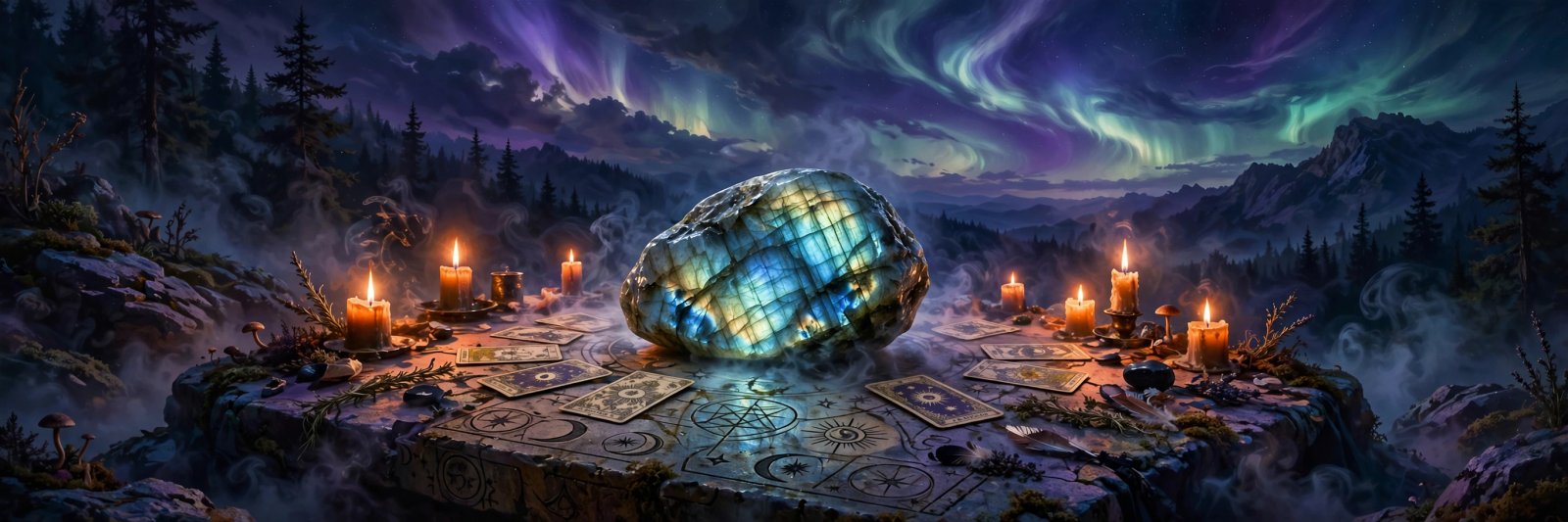
Grandma's Stones
My grandmother wasn't a stranger to stones. A birthstone for a new mother was a common enough gift in the hollers — something small, something with your child's month in it, tucked away or worn close. That was the extent of it. Stones weren't reached for the way roots and herbs were; they weren't gathered along the road or pulled from the creek bed.
Labradorite wasn't one of hers. It has no place in the birth basket, no place in the old remedies. This one came later, and came from somewhere else entirely.
The Fire Rock
Before it had a Western name, labradorite belonged to the Inuit, who called it fire rock and told the spear-and-aurora story as the reason light lived inside stone. Archaeological finds put Algonquin use of the stone as far back as 1000 CE. It wasn't until 1770, when Moravian missionaries encountered it in Labrador, that the rest of the world took notice — and by the 1800s it had made its way into French and English jewelry, prized for a shimmer nobody could quite explain.
So this is a young stone, as these things go. Its story doesn't run through Appalachia. But its story is old anywhere it did run, and that counts for something.
A Stone That Fits Anyway
Even without roots in the mountains, labradorite settled easily into ideas the hollers already knew well.
- Second Sight — the old gift of prophetic dreaming, of seeing what others couldn't. Labradorite's flash, called labradorescence, looks like a glimpse through a veil — gone as quick as it appeared.
- Warding the Bad Eye — charms against envy and ill will are old mountain practice. A stone that shows its color only at certain angles, and looks like plain dark rock the rest of the time, is a fitting thing to carry when you'd rather not be noticed.
- Between-Times — dawn, dusk, the turning of a season — the hours mountain magic already treats as thin and potent. A stone that goes from dull grey to full rainbow in a single turn of the wrist is that idea, made physical.
None of this is inherited. It's borrowed, and worn well.
Working With Labradorite
Element
Water and Air
Chakra
Third Eye, Throat, and Crown
Primary Work
Intuition, transformation, and quiet protection
What It's Used For
- Sharpening intuition and trusting a gut feeling already forming
- Steadying yourself through a change you didn't choose
- Waking up a talent or instinct you didn't know you had
- Keeping your own energy a little harder to read
- Better dreams, or dreams worth remembering
How to Work With It
Hold it during quiet, still moments — meditation, or just sitting with a decision you haven't made yet. Some keep it under the pillow for the dreams. Some keep it on the reading table, next to the cards. There's no wrong way to sit with a stone; the wrong way is not sitting with it at all.
Cleansing & Charging
Moonlight suits it, especially a new moon. Running water works. So does smoke, if that's your practice. Charge it under a full moon, or let it sit near a storm — labradorite seems to like weather with some motion in it. Keep it out of long direct sun; the flash fades.
Stone Pairings
Amethyst
Deepens the intuitive work.
Moonstone
A natural pairing, both tied to the moon and the unseen.
Clear Quartz
Amplifies whatever labradorite is already doing.
Black Tourmaline
Grounds the protection side while you do the rest.
Some come from the birth basket.
And some come from a spear thrown at the sky,
carrying just enough light
to still be flashing, centuries later.